



Maybe there is a life insurance exam on the calendar, or a surgery date. Maybe you quit last week and just want to know when your body is actually done with it. The answer to both starts with a word most people have never heard: cotinine.
We make nicotine replacement, so along with the test windows, we will be straight about what our mints do to a test.
TL;DR
Nicotine has a half-life of about 2 hours, so it falls out of your blood within hours. Tests look for cotinine, its breakdown product, which averages a 16-hour half-life. After daily smoking, cotinine in urine, blood and saliva usually drops below test cutoffs about 3 to 4 days after your last nicotine, and researchers allow 6 to 7 days for slow metabolizers, while hair can reflect several months. Only time clears it, and nicotine mints, gum and patches show up on these tests too.
| Test | Measures | Typical window |
|---|---|---|
| Urine | Cotinine | About 3 to 4 days; allow 6 to 7 |
| Blood | Cotinine | About 3 to 4 days; allow 6 to 7 |
| Saliva | Cotinine | About 3 to 4 days; allow 6 to 7 |
| Hair | Nicotine & cotinine | Several months (hair grows about 1 cm a month) |
Day windows are modeled on average US cigarette smokers. Sources: SRNT biochemical verification update (2020); Benowitz, Hukkanen and Jacob (2009).
Chapter 1: What nicotine & cotinine are
Two molecules, two very different clocks
Nicotine is the addictive drug in cigarettes, vapes and pouches, and it is also the active ingredient in nicotine replacement like our mints. Once it reaches your blood, your liver does most of the work of breaking it down. In people, about 70 to 80% of nicotine is converted into one compound, cotinine, according to a review of nicotine metabolism by Benowitz, Hukkanen and Jacob.
The nicotine half life, meaning the time it takes for half of it to leave your blood, averages about 2 hours. Cotinine averages about 16 hours. Eight times longer.
Use nicotine all day and cotinine rises gradually and stays fairly level, while nicotine itself spikes and dips with every cigarette or puff. That slow fade is why labs measure cotinine. The same review does not recommend measuring nicotine for general testing because it clears so fast, and calls cotinine the best marker of tobacco use when no nicotine medication is involved. For background on the molecule itself, see cotinine on Wikipedia; the half-lives above come from the clinical research.
Chapter 2: How long nicotine stays in your system by test type
The window depends on the sample
So, how long does nicotine stay in your system? For a daily smoker, urine, blood and saliva tests usually stop finding it about 3 to 4 days after the last cigarette. A 2020 review from the Society for Research on Nicotine and Tobacco (SRNT) estimates that cotinine takes about 80 to 100 hours after quitting to fall from average pre-quit levels to the cutoffs researchers use to tell smokers from nonsmokers. Those figures are based on US cigarette smokers.
That is an average, not a promise.
The same review notes that cotinine's half-life ranges from about 8 to more than 30 hours between people. In its example, a fast metabolizer falls under the cutoff in about 2 days, while someone with a 30-hour half-life needs about 150 hours, a little over 6 days. So when a study needs to confirm that a smoker has stopped, the authors say it is reasonable to allow 6 to 7 days. Someone who used less starts lower and, in the review's models, reaches the cutoff sooner. Vapes and pouches were not modeled separately.
Nicotine in urine
Usually 3 to 4 days, sometimes longer
How long does nicotine stay in urine? About 3 to 4 days for most daily smokers, by the SRNT math above. Urine holds a higher concentration of cotinine than blood or saliva, which the review says gives it the greatest sensitivity, though results vary more from sample to sample.
It is also the test you are most likely to meet outside a hospital. The University of Rochester Medical Center lists quit-program check-ins, jobs at companies that prohibit smoking and insurance health exams among the reasons people get one. Its guide is more cautious on timing: after 7 to 10 days without smoking or nicotine exposure, it says, cotinine levels start to return to normal.
Nicotine in blood
Nicotine for hours, cotinine for days
How long does nicotine stay in your blood depends on which molecule the lab checks. Nicotine itself drops fast: after a day of regular smoking, meaningful blood levels last about 6 to 8 hours past the last cigarette. Blood cotinine follows the same 3 to 4 day pattern as urine, at lower concentrations; Benowitz and colleagues note that cotinine reflects roughly the past 3 to 4 days of use. Serum or plasma cotinine reads close to saliva cotinine, and the SRNT review treats the two as interchangeable.
Nicotine in saliva
A cheek swab tells the same story
How long does nicotine stay in saliva? About as long as in blood, roughly 3 to 4 days for cotinine after daily smoking. Saliva tracks blood closely, and collecting it takes a swab instead of a needle.
Over-the-counter cotinine test strips exist for urine and some for saliva. The SRNT review calls them quick and cheap but only semiquantitative, with limited sensitivity and precision, so treat a home strip as a rough guide.
Nicotine in hair
The longest memory of any test
Hair is the outlier. Nicotine and cotinine are built into hair as it grows, and hair grows about 1 cm a month, so Benowitz and colleagues say measuring it may show a person's nicotine exposure over several months. The SRNT review gives no day count for hair, and neither do we.
Hair results are hard to compare, though. Dark hair binds much more nicotine than blond or white hair, and secondhand smoke can settle on hair from outside, which washing does not fully remove.
Chapter 3: What changes how fast nicotine clears
Why your number may not match a friend's
Ask how long does nicotine stay in your body and the honest answer has two parts: how much went in, and how fast you clear it. Cotinine halves on a schedule, so a higher starting level takes longer to reach a cutoff. In the SRNT models, starting at three times the cotinine level added about a day at the average half-life and about 2 days at the slowest.
Intake varies a lot by product and habit. A pack-a-day smoker and someone using a few lozenges are not carrying the same load; our guide to nicotine in vapes & cigarettes breaks down how much your body actually absorbs. Nicotine replacement usually produces cotinine levels around 30 to 70% of those seen while smoking.
Then there is your body. These factors changed clearance in the studies Benowitz and colleagues reviewed:
- Genes. The liver enzyme CYP2A6 does most of the work, and its activity varies widely between people.
- Sex & hormones. In a twin study, women cleared cotinine about 24% faster than men, and oral contraceptives sped it up further. Pregnancy more than doubles cotinine clearance compared with after delivery.
- Age. Adults over 65 had about 23% lower nicotine clearance than young adults.
- Kidneys & liver. Kidney failure slows clearance of both nicotine and cotinine, and liver disease affects cotinine metabolism.
- Ancestry. Average cotinine clearance was lower in Black and Chinese American smokers than in white smokers in US studies.
None of this is something you can change before a test next week. It does explain why two people who quit on the same day can get different results.
Chapter 4: How to get nicotine out of your system
The clock does the heavy lifting
Search for how to get nicotine out of your system fast and you will find detox drinks, cranberry juice and sweat sessions. We could not find human research showing any of them get cotinine under a test cutoff sooner. The method the science supports is plain: stop all nicotine and let the half-lives run.
The popular fixes fall short for a reason. Under normal conditions your kidneys handle only about 5% of nicotine elimination; your liver does most of the rest. Cotinine is heavily reabsorbed in the kidneys, and only about 10 to 15% of the nicotine a smoker absorbs leaves in urine as unchanged cotinine. We found no study showing that extra water speeds that up.
Exercise gets the same verdict. Activity changes blood flow to the liver, which in theory could change nicotine clearance, but we found no study showing a workout gets cotinine below a cutoff faster. Grapefruit juice has actually been tested: in nonsmokers given nicotine by mouth, it slowed the switch to cotinine and raised kidney clearance, with no significant net effect on nicotine exposure.
If a test is close, here is what helps:
- Stop every source, including mints, gum, patches, pouches and vapes.
- Stay away from secondhand smoke, which URMC notes can affect results.
- Count from your last dose. After daily smoking, plan on at least 4 days for urine, blood or saliva, and 6 to 7 if you can, the margin SRNT allows for slow metabolizers. It is a margin, not a guarantee.
- Tell the person ordering the test about any nicotine replacement you use.

Stopping all nicotine at once also means withdrawal. The National Cancer Institute says symptoms are usually worst in the first week and peak in the first 3 days, the same stretch a test cares about. Our nicotine withdrawal timeline walks through what to expect day by day.
Nicotine in your system FAQ
What quitters ask us
Does nicotine show up on a drug test?
Only when the test looks for it. Nicotine has its own nicotine test, usually a cotinine test on urine, blood or saliva. So does nicotine show up in a drug test? On a cotinine test, yes. The University of Rochester Medical Center notes that companies that prohibit smoking and some insurers use one. If a form or lab order mentions nicotine, tobacco or cotinine, assume it is being checked.
How long before surgery should you stop nicotine?
As long as your surgeon tells you to, since they know your procedure. As our guide to nicotine before & after surgery explains, most elective procedures call for at least 4 weeks nicotine-free, and orthopedic, cosmetic and cardiothoracic surgery 6 to 8 weeks. Dental procedures need at least 24 to 72 hours, though 4 weeks is ideal. Most surgeons mean all nicotine, mints and patches included, because nicotine itself narrows blood vessels and slows healing. Some allow low-dose NRT during a taper, so confirm your plan with yours.
Do nicotine mints show up on a nicotine test?
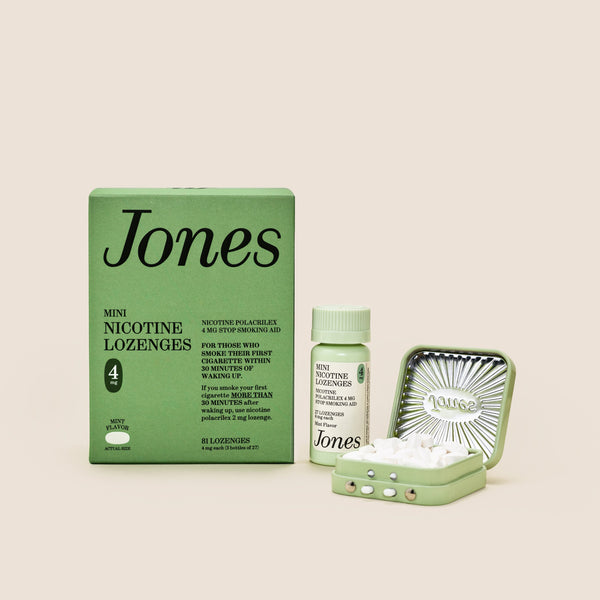
Yes. Jones nicotine mint lozenges contain nicotine, your body turns it into cotinine, and a cotinine test will come back positive while you use them and for days after. Nicotine replacement typically produces cotinine at about 30 to 70% of smoking levels. Tests for anabasine and anatabine, compounds found in tobacco but only in negligible amounts in medicinal nicotine, can tell tobacco use apart from NRT, though less reliably for vaping. Tell whoever orders your test that you use NRT.
More guides to nicotine & your body
Keep reading
 Mental health & cravings
Nicotine before and after surgery: Timing and risks
 Hilary Dubin, Co-Founder & Co-CEO of JonesJun 2, 2026
 Mental health & cravings
Nicotine withdrawal timeline for smoking & vaping
 Caroline Huber, Co-Founder & Co-CEO of JonesJan 13, 2025
How much nicotine is in vapes & cigarettes (mg vs %)
Hilary Dubin, Co-Founder & Co-CEO of JonesMar 4, 2026